
What Juttay Means, and Why a Sneaker Studio Took the Word
2 August 2026 · 6 min read
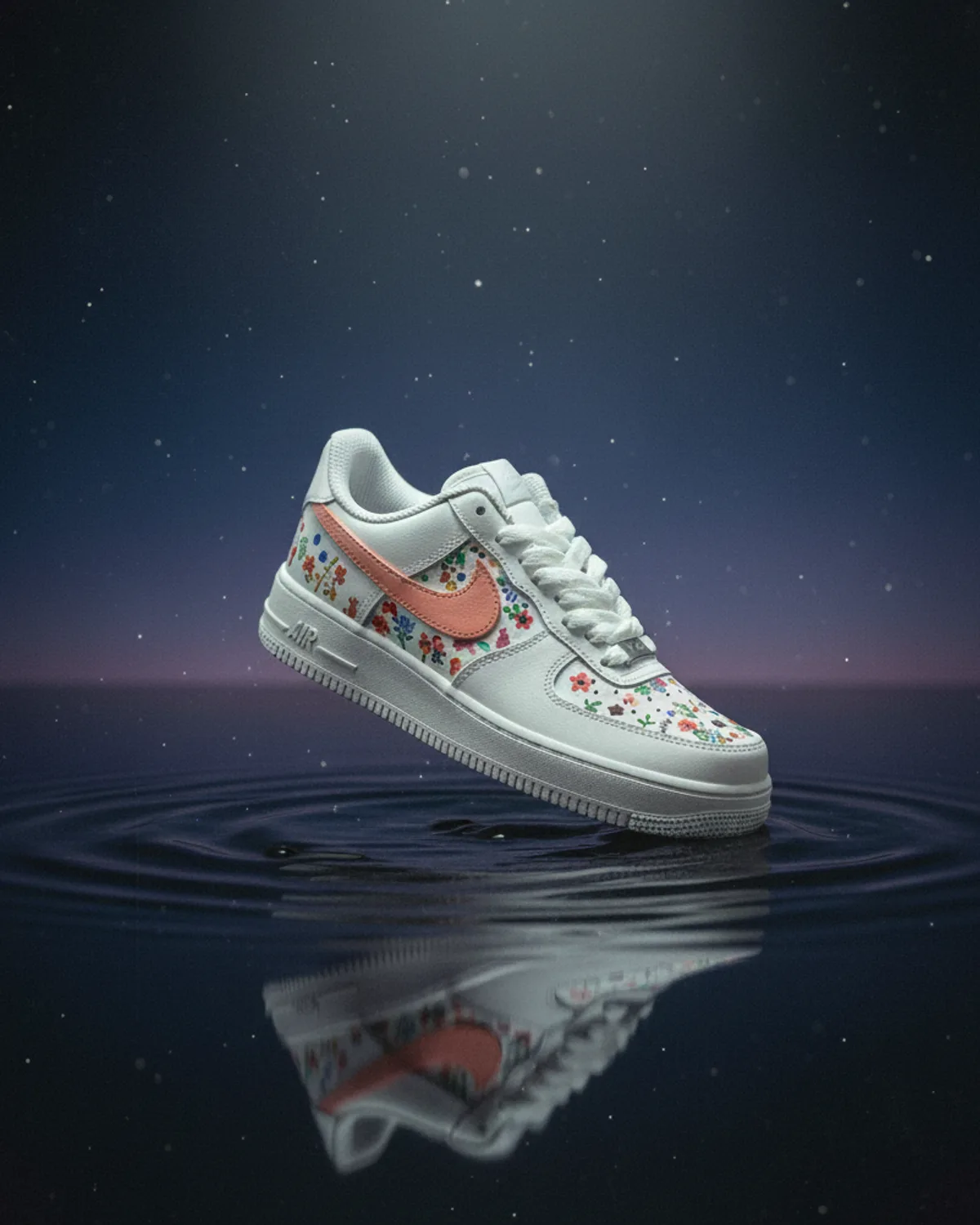
Type juttay into a search bar and the results come back in gold thread. Rows of embroidered leather flats, curled toes, mirror work, bridal sets photographed on marble. Then there is us: a studio in Islamabad that paints Nike Air Force 1s by hand and answers to the same word. Two very different objects under one name, and neither of them is using it wrongly. This is the explanation both halves deserve.
Start with the word itself, because it is far plainer than the search results suggest. In Urdu and Punjabi, joota is a shoe. Jooti is the feminine form. Juttay is the plural, and it means, with no ceremony whatsoever, shoes. It is the word in the sentence your mother says when you head for the door without them on. It is the word for the rack in the hallway and for whatever is on your feet right now. That flatness is the entire reason we took it, and we will come back to it.
The confusion starts because the same traditional shoe collects different names as you move across the region. In Indian Punjab, the embroidered leather slip-on is a jutti. In Pakistan the same shape is usually called a khussa, particularly around Multan, Bahawalpur and Lahore. In Rajasthan and much of India it is a mojari, and you will also meet nagra and saleem shahi attached to particular shapes and heights. Outsiders swap these words freely. The people who make them do not. Ask for a jutti in a Pakistani bazaar and you will be handed a khussa.
That shoe deserves a proper paragraph rather than a respectful nod. A khussa is built from vegetable tanned leather, with an upper often cut from a single piece and closed to the sole with no separate left and right, so a new pair takes the shape of its owner's feet over the first weeks of wearing. The surface is embroidered in tilla, a metallic thread, and depending on the region it carries mirrors, cowry shells, small brass nails, ceramic beads, sometimes bells. Cutting, dyeing, stitching, embroidery and finishing are distinct skills, and one pair is days of an artisan's work. The form had royal patronage centuries before it had a shop window.
It is also a living craft rather than a museum case. There are workshops in Multan and Lahore making khussa this week, and across the border Amritsar and Patiala do the same for Indian Punjab, exporting to a diaspora that grew up in them. Crafts like that survive by being bought, not by being admired in an article about a different kind of shoe.
So let us be exact about what we are, since the search results file us next to them. Painted Juttay does not make khussa. We do not make jutti or mojari. We have no training in that craft, no lineage in it, and no interest in blurring the line to catch traffic that was looking for someone else. If you came here for embroidered flats for a mehndi, we are not your studio, and the studios that are will be found under khussa, not under our name.
What we do is narrower than that and starts somewhere else entirely. Every commission begins as a brand new Nike Air Force 1. An artist in the Islamabad studio prepares the leather panels and paints them by hand, freehand, with no concept sketch stage in between, using high grade acrylics and oils. The artwork is then sealed with a flexible finisher and a waterproof coat so it bends where the shoe bends. Painting runs five to seven days. No design is ever repeated. The people doing the painting have names: Rabail Ali Zaidi, Sarah Maqsood, and The Kharazmi Sisters.
Which brings back the flatness of the word. Juttay is not the name of a technique, a lineage or a tradition. It is the name of an object: shoes, any shoes, the ones by your door. What we share with a khussa maker is not method, it is an assumption so settled in this part of the world that nobody thinks to defend it, namely that a shoe is a surface a person decorates by hand, one pair at a time, usually for somebody specific. Seen from here, painted footwear is not the experiment. The plain undecorated shoe is the recent idea.
The honest difference is where the ornament enters. A khussa is decorated in the making, embroidered while it is still flat leather, before it has become a shoe at all. Our canvas arrives from a factory in the millions, identical to every other, and receives its artwork afterwards, on a bench, from one person over several days. One tradition builds the art into the object. We add it to an object that was never designed to carry any. That distinction is worth stating rather than smudging, and it is exactly why we took the everyday word for shoes instead of the name of somebody else's craft.
So both sets of results are telling the truth. If you arrived wanting gold embroidery for a wedding, you now have the right words to search with: khussa, jutti, mojari, and the towns that are known for each. If you arrived typing painted juttay, custom juttay or hand painted juttay, you have found the studio those words belong to, and the rest of this site is the long answer.
Juttay means shoes. Everything painted on top of them is the part that is yours.
Ready to Start Your Own?