
A Portrait That Has to Survive Being Walked In
13 October 2026 · 5 min read
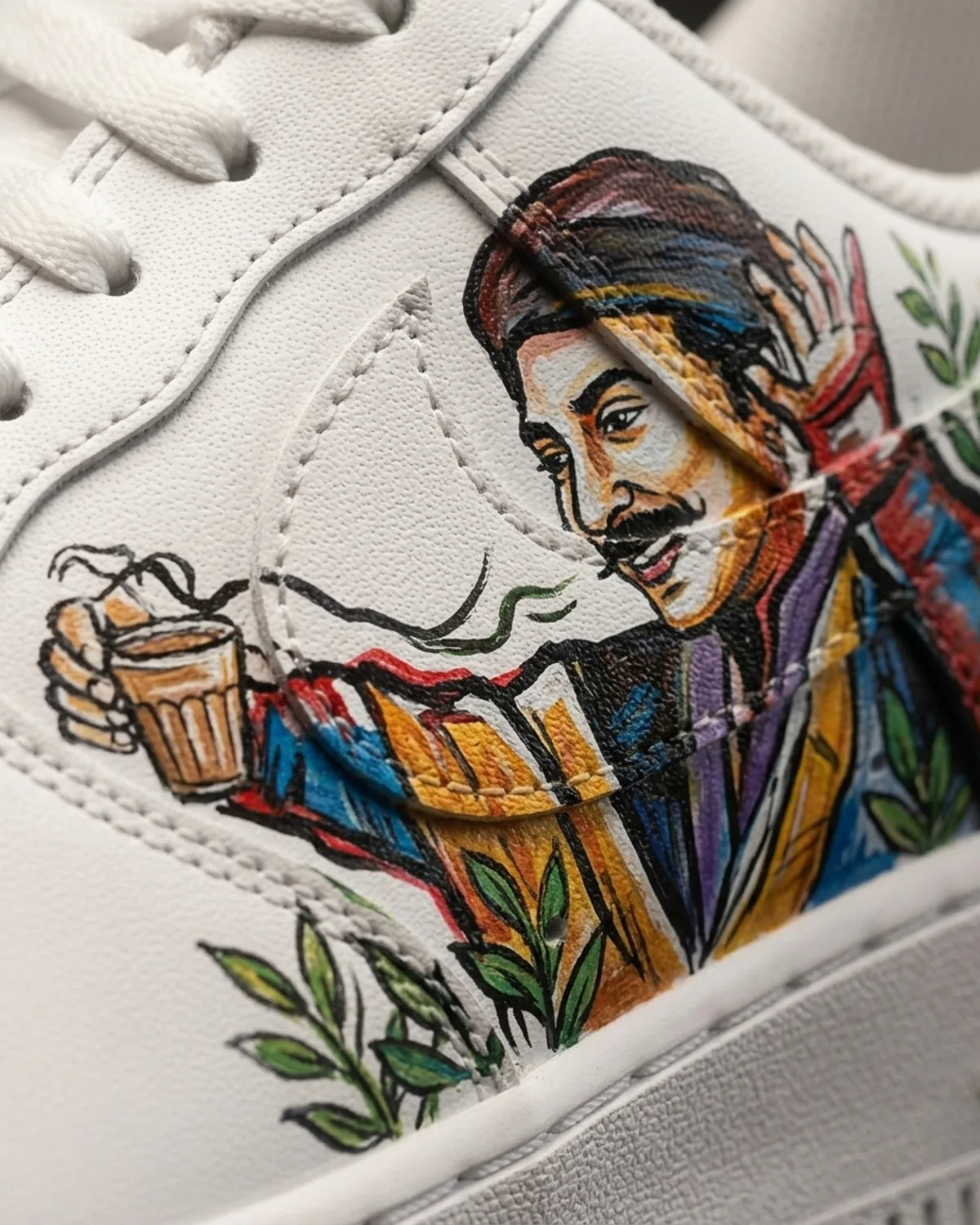
The Storyteller carries a full-colour figure on the quarter: a man in a striped shawl with a glass of chai raised, caught mid-sentence. On the other shoe there is a radio, a few notes lifting off it, and green leaves carried round the toe. It is the most pictorial thing we make, and it is the clearest case of a problem that applies to every painted shoe, only more so. A painting on a wall is asked to hang still. A painting on a shoe is asked to go out.
Start with where the face goes. The quarter panel of an Air Force 1 is the largest flat area on the shoe, but flat is relative: it still curves away towards the heel and it creases diagonally when the foot flexes. A face placed too far forward lands on the flex zone and will, over a year, develop a line through it. The figure here is set back, with the crease running below the shoulder rather than across the features, which is a composition decision taken for a mechanical reason.
Then there is scale. The head is about the width of a thumbnail. At that size the features cannot be painted as features, because a brush capable of a convincing eye at two centimetres cannot also lay the shawl. The face is built from fewer marks than it appears to have: a dark mass for the hair, two short strokes for the eyes, one for the moustache, and a warm mid-tone doing the rest. The impression of detail comes from the marks being in the right places, not from there being many of them.
Colour is where this design earns the white leather around it. There are maybe eight colours in the figure, from the ochre of the cup to the deep maroon in the shawl, and they are saturated. Against another colour they would argue. Against bare white they resolve, because white gives every one of them the same neutral neighbour. This is the same reason the leaves are allowed to run round the toe in green: they travel across untouched leather, so they never have to negotiate with anything.
The second shoe is doing something a single shoe cannot. It carries the radio and the notes, which turns the pair from a portrait into a scene. You cannot see both shoes properly at once, which means the design is sequential: somebody notices the figure, and then later, from a different angle, notices what he is listening to. Designing for a pair rather than for a shoe is one of the few genuine advantages footwear has over canvas, and it is mostly unused.
On sealing, there is no clever answer and we would rather say so than imply one. The paint is flexible acrylic, keyed to the leather and sealed, and it is tested by flexing the finished shoe by hand before it ships. It will outlast ordinary wear by years. It will not survive being scuffed along a kerb, and no finish on any painted shoe from any studio will. A pictorial pair asks slightly more care than a block-colour one simply because the damage shows on a face.
What we would say to anyone considering a portrait pair is that the subject matters more than the likeness. This one works because it is a scene somebody actually recognises: the shawl, the cup, the radio, an evening that a particular person had. A technically better painting of nobody in particular would be a worse shoe.
Ready to Start Your Own?