
One Red, and Why It Does More Work Than Five Colours
13 October 2026 · 5 min read
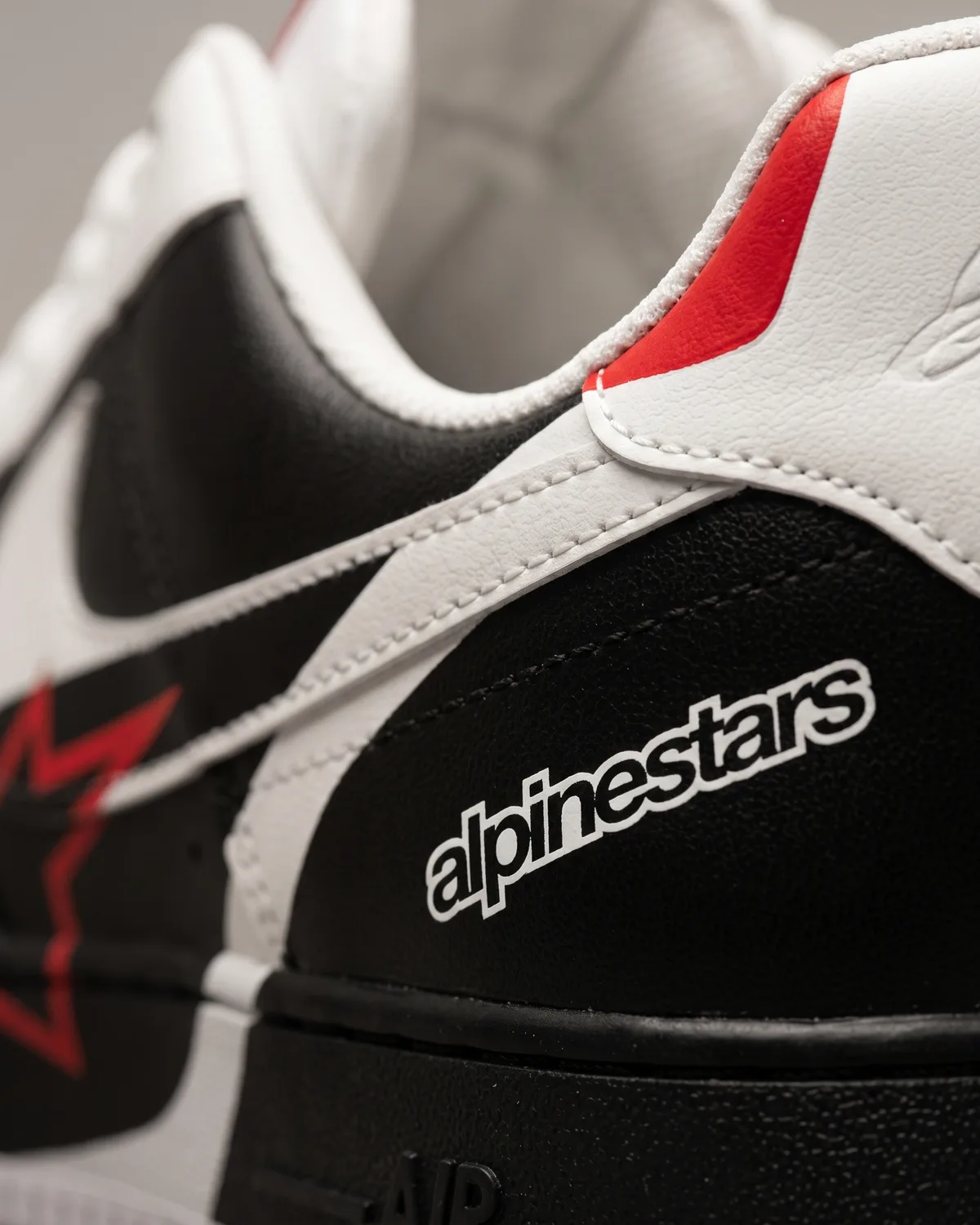
There is a persistent assumption that a restrained design is an easier one to execute. Fewer colours, less drawing, less to go wrong. In practice the opposite holds, and the Alpine Stars pair is a clean demonstration. It uses three colours. Deciding where the third one went took longer than painting the first two.
The structure is simple enough to describe in a sentence. The quarter and toe go matte black, a single swept panel of white runs the midfoot, and fine silver lines follow that sweep the way a decal sits across a set of racing leathers. Nothing in that is difficult to paint. What is difficult is that it leaves the shoe with exactly one unresolved question: where does the red go.
Red appears in three places on this pair and nowhere else. A star on the quarter, the collar lining, and the heel tab. That is a deliberate restriction, and it is the entire design. Put red on the swoosh as well and the shoe becomes a colour scheme, which is a different and considerably less interesting object. Put it only on the star and the back of the shoe dies. The three placements are what makes the eye travel from the quarter, round the collar, to the heel, which is the path somebody walking behind you actually sees.
The silver pinstripes are the part most people do not consciously notice and would miss immediately. They are painted with a liner brush, thin enough that they read as a reflection rather than as paint, and they exist to give the white panel a direction. Without them the white is a shape. With them it is a sweep, and the shoe looks like it is moving while standing still. This is a borrowed trick and we are happy to say where it is borrowed from: it is what every motorcycle leather manufacturer has done since the 1980s.
The wordmark is lettered by hand on the quarter, beside the star. At that size the letters are about four millimetres tall, which is near the limit of what can be done with a brush rather than a pen on grained leather. Grain is the problem: the surface is not flat at the scale the brush is working at, so a stroke that would be clean on paper picks up and skips. The answer is a slower hand and more passes at lower load, which is also why small lettering takes disproportionately long.
It is worth saying plainly that a pair like this is a tribute, and tributes have a line in them. We paint the marks and the colours of things people love, on one pair, for the person who loves them. We do not produce runs of them, we do not claim any association with the companies whose motifs appear, and we would not take a commission to make forty of these for resale. The distinction between an homage painted once by hand and a counterfeit produced in quantity is not a subtle one, and we stay well clear of it.
If there is a general principle here, it is that restraint is a decision made repeatedly rather than a decision made once. Every time this shoe could have had more red on it, somebody chose not to add any. That accumulates into something that looks effortless, which is the usual reward for work nobody can see.
Ready to Start Your Own?