
Why the Air Force 1 Is the Best Canvas Nike Ever Made
1 August 2026 · 6 min read
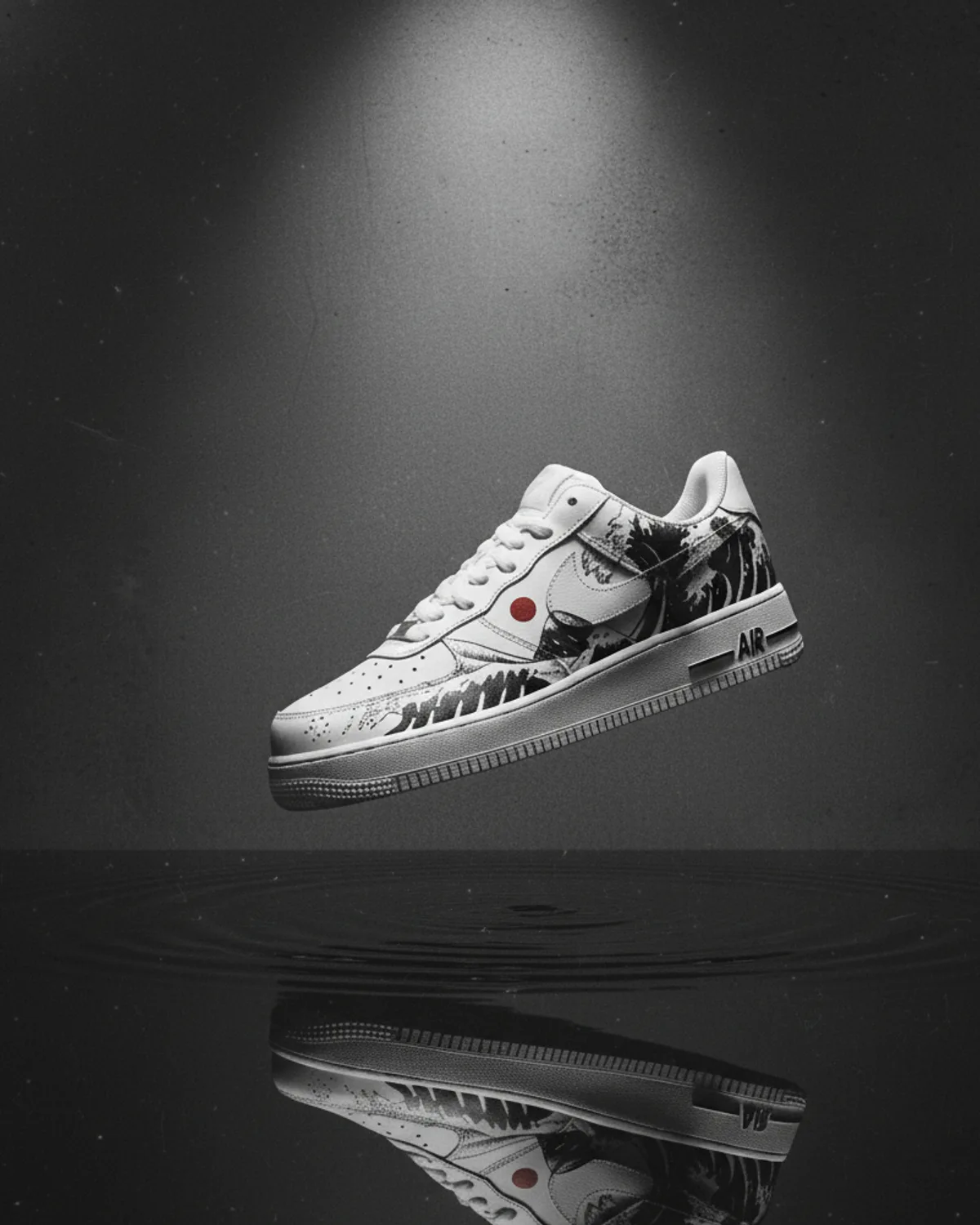
Ask a painter why the studio's default canvas is the Air Force 1 and you get a craftsman's answer rather than a hype answer. The AF1's quarter panels are broad, smooth and gently curved, which means leather that takes layered paint evenly and holds fine linework without fighting the brush.
It helps to name the parts, because the argument is really about geography. The quarter panel is the large field along the side of the shoe. The vamp sits over the toe. The mudguard wraps the lower edge, the eyestay carries the lacing, the heel counter closes the back, and the foxing stripe is the flat band running around the midsole. An AF1 gives an artist one generous unbroken field, several smaller ones that frame it, and a continuous border at the bottom. Very few silhouettes offer all three.
The leather is the next reason, and it is the one most people miss. The AF1 upper is tumbled full grain, which has a shallow, even texture. Acrylic sits down into it and cures flat. Paint on a heavily textured or knitted upper behaves differently: it pools in the low points and starves on the high ones, so a flat colour dries patchy and a fine line breaks up wherever the weave crosses it. Nothing about that can be fixed by painting more carefully.
The foxing stripe is a surface most people never think of as a canvas, and it is one of the reasons a design can look finished rather than merely placed. It is flat, continuous and it runs the whole way round, so it will take a border or a repeat without interruption. Below it carries a Greek key meander in terracotta, the border the Greeks put around anything they meant to last.
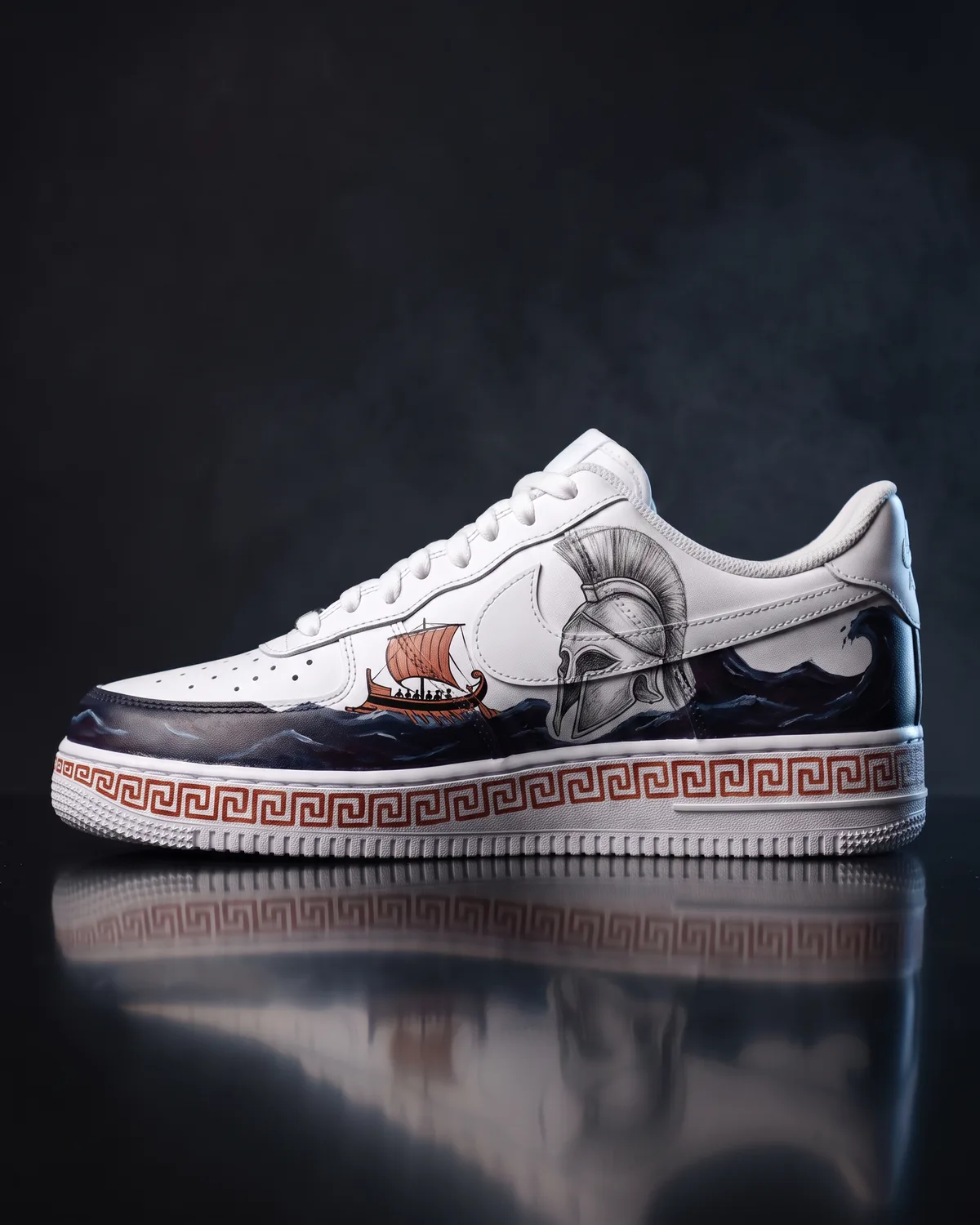
Curvature matters as much as area. The AF1's panels are gently convex, close enough to flat that a straight line drawn across one still reads as straight from a normal viewing distance. On a sharply curved or aggressively panelled silhouette the same line bends away from the eye, so lettering skews and a face distorts. An artist can compensate, but compensating is time spent on the shape of the shoe instead of on the work.
The quarter panel also takes a large block of flat colour without banding, which is harder than it sounds. A saturated field wants to dry unevenly and every lap mark shows. On this leather it can be laid in thin layers until the colour has depth, so it moves under light rather than sitting dead.
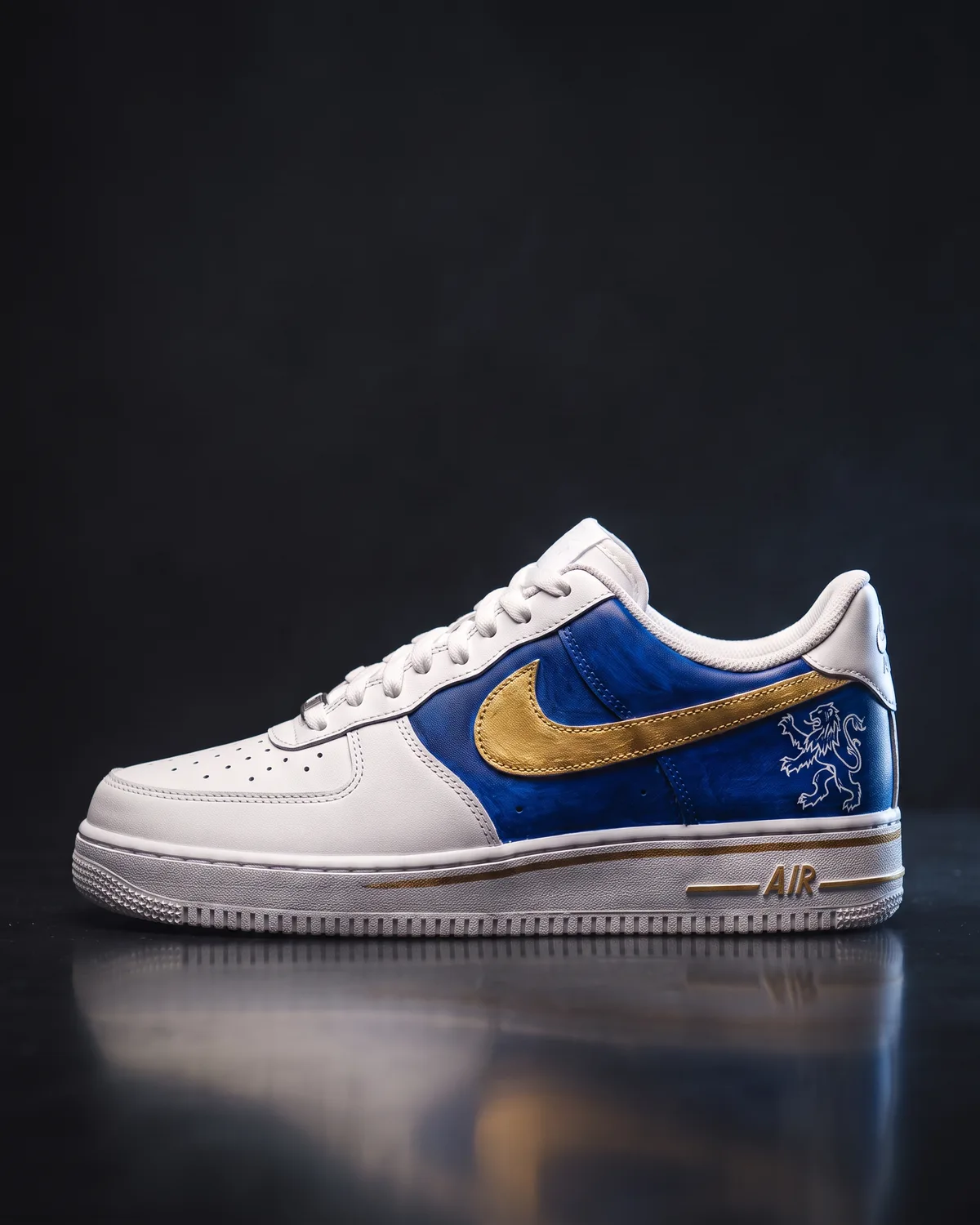
White leather matters more than it seems. It is not blankness, it is contrast. Black ink work turns architectural against it, colour keeps its saturation, and the shoe's own stitching becomes part of the composition instead of noise.
The silhouette does the rest. Forty years of streets have made the AF1's shape instantly legible, which means artwork on it reads as intentional rather than as costume. A design sits inside a frame everyone already recognises, which is the same reason galleries hang new work in old rooms.
None of this makes other shoes unpaintable. It makes them a different job. Suede takes pigment but loses its nap where it is worked. Mesh and knit suit dye better than paint. A patent finish has to be abraded before anything will key to it, and once it is abraded it is no longer patent. All of these are solvable, and we solve them when a patron ships in a pair they already own.
That is the whole case. When a commission starts from nothing, it starts on an AF1, because the canvas should never be the reason a design compromises.
Ready to Start Your Own?
Or see the work first: custom Air Force 1, what a commission costs and how the paint holds up.
Or explore by theme: custom Air Force 1 ideas, every direction in one place.