
Custom AF1 Designer, Borrowing the Language, Not the Logo
24 August 2026 · 5 min read

A designer-style brief is usually a request for a feeling rather than a specific house: the restraint, the tonal palette, the sense that every mark was considered and nothing was added to fill space. That feeling is real and it is worth chasing, and it has almost nothing to do with copying a monogram. The pairs that read as fashion read that way because of what was left off, not because a logo was stamped across them.
Dior Force is the studio's own take on that register. It works in soft greys and off-white with a near-black, a tonal, quiet palette that lets the cut of the shoe and the quality of the mark do the talking. There is no loud colour and no crowding, which is exactly the point: the discipline of a fashion house is subtraction, and a pair in that spirit earns its look by holding back rather than piling on.
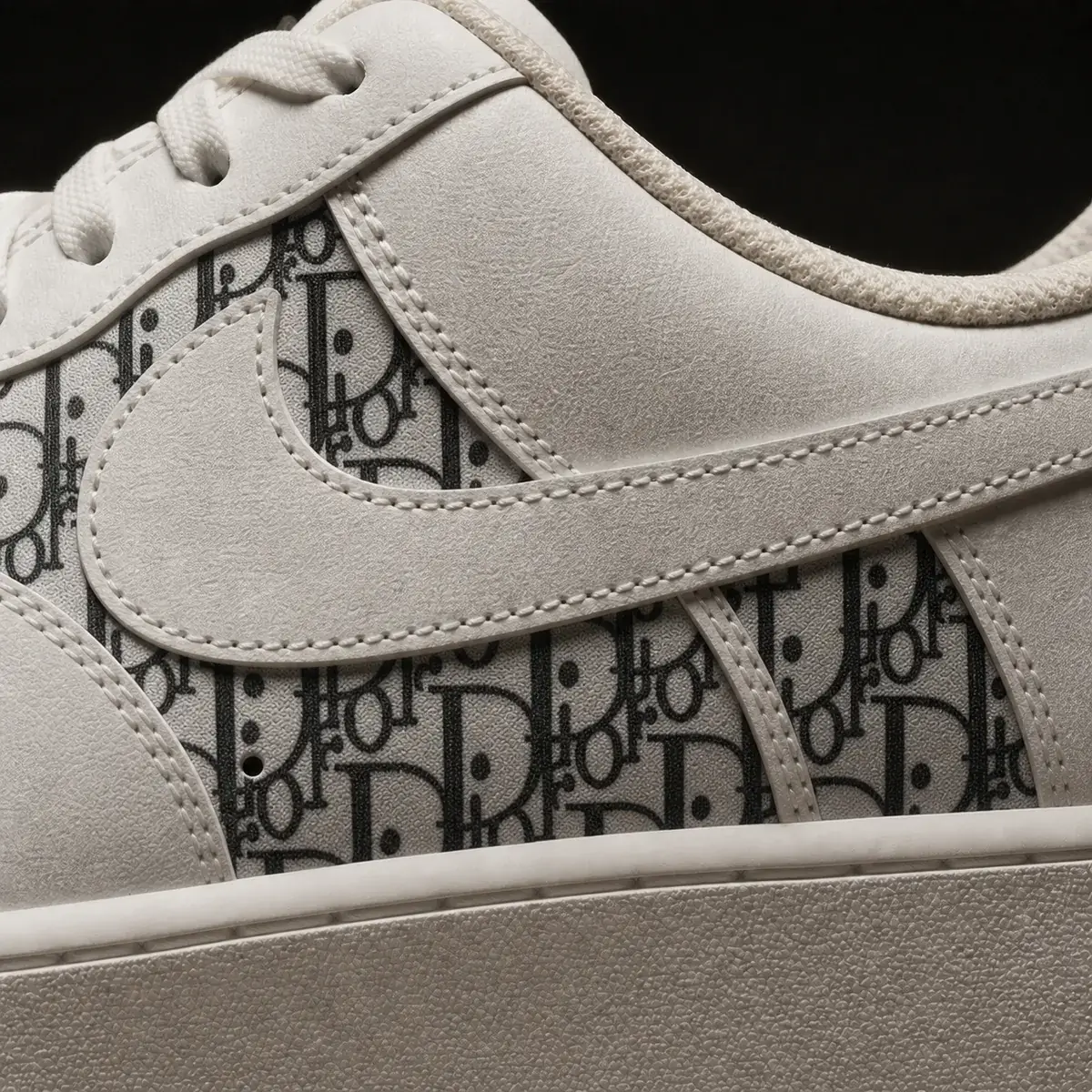
The technical heart of a tonal pair is that grey is the hardest colour to keep clean. A grey mixed carelessly goes muddy or drifts warm or cold from one panel to the next, and on a shoe that is meant to look considered, a drifting grey reads as a mistake. So the greys here are mixed in a single batch and controlled across the whole shoe, and the near-black is a true deep rather than a flat one, because the entire effect depends on the tones agreeing with each other.
Pattern, if there is any, wants to be quiet and structural. A tonal geometric worked into the panel, a texture that only appears in certain light, a repeated mark used as rhythm rather than as branding: those carry the fashion feeling. A bright all-over logo print does the opposite, because the whole language being borrowed is one of understatement, and shouting breaks it. Restraint is not the safe option here, it is the actual brief.
Placement is the usual discipline. Quiet pattern and considered detail read best on the flat quarter and the heel, and a tonal treatment can run across the whole shoe cleanly because it is not asking any fine line to survive the forefoot crease. Where a delicate motif is used, it belongs above the fold, so the shoe still looks considered after it has been worn rather than only in the box.
Here is the part we say plainly. A fashion house's monogram, name and logo are its trademarks, and we will not copy them or present a pair as a product of that house. We paint a pair in the spirit of a look, restraint, palette, craft, for the person who asked, which is lawful and, frankly, the more tasteful object. A shoe that borrows a house's discipline says more than one that borrows its logo, and it is the pair we would rather make.
Tell us the feeling you are after rather than the logo, and we will paint the version that belongs to you.
Ready to Start Your Own?
Or see the work first: custom Air Force 1, what a commission costs and how the paint holds up.
Or explore by theme: custom Air Force 1 ideas, every direction in one place.