Why Hand-Painted Beats Printed
20 April 2026 · 5 min read
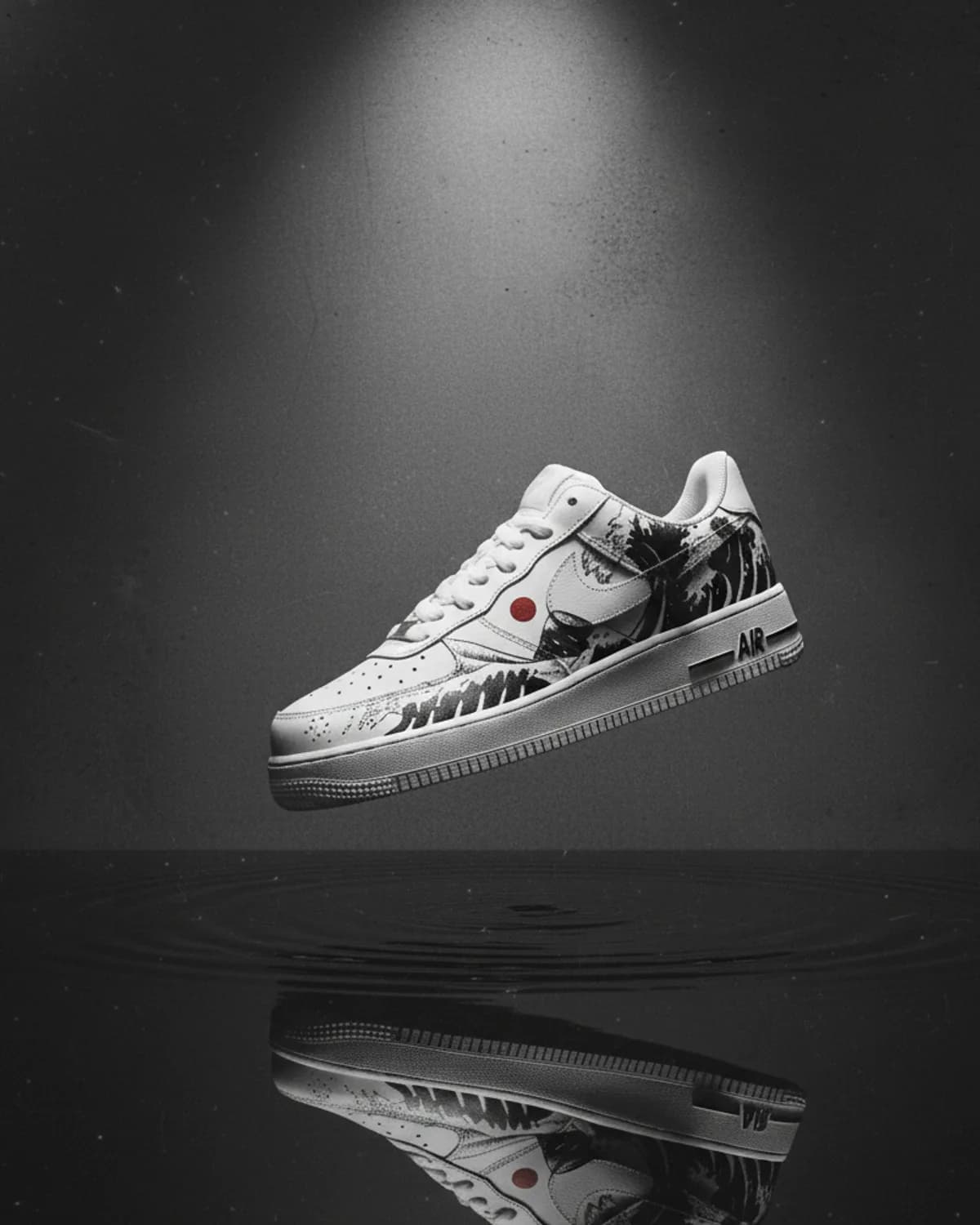
Somewhere right now, a machine is printing the same graphic onto its four-hundredth shoe of the day. The registration is perfect. The colours are consistent. Every unit is identical to the last, which is exactly the point — and exactly the problem. A printed sneaker is a copy before it is anything else. It can be a good copy, even a beautiful one, but it enters the world already outnumbered by its own siblings.
A hand-painted shoe starts from the opposite premise. When one of our artists loads a brush and touches it to the quarter panel of a fresh Air Force 1, there is no file to reprint from. There is a sketch, a plan, years of muscle memory — and then there is the specific way the bristles drag across grained leather on that specific afternoon. The line that results has weight at one end and lightness at the other. It thickens where the artist pressed and breathes where they lifted. No printer produces that, because no printer hesitates.
That hesitation is not a flaw. It is the signature of a decision being made in real time. Look closely at any hand-painted panel and you can read the order of operations: which layer went down first, where a colour was pulled wet into another, where the artist came back the next day and sharpened an edge. Print flattens all of that into a single simultaneous instant. Paint keeps the time inside it. This is the same reason a painting in a museum holds your attention in a way a poster of it never will — you are looking at hours, not at an image of hours.
It is worth being honest about stencils, because they sit in the murky middle. Plenty of "custom" sneakers are made by cutting a vinyl stencil, sponging paint through it, and calling the result hand-made. Technically a hand was involved. But a stencil is just a slow printer: the design exists before the shoe, complete and repeatable, and shoe number fifty looks like shoe number one. We do not use them. Every line on a Painted Juttay commission is drawn freehand, which is slower, riskier and more expensive — and the entire reason the work has any claim to being art rather than production.
Then there is the phrase "one of one", which streetwear has abused nearly to death. Brands stamp it on limited runs of five hundred. Customizers use it to mean "I only made this batch once." When we say it, we mean something stricter: your design is composed for you, painted once, and then retired. We keep the photographs for our archive, and we will happily paint the same theme for someone else — but never the same composition. When your pair is finished, its design leaves the catalogue of possible things. Nobody, including you, can order it again.
That retirement policy is not marketing garnish; it changes what the object is. A printed shoe is a licence to display a design that thousands of others also display. A true one-of-one is closer to a portrait. It answers to your story — the couple's names worked into calligraphy, the city skyline you grew up under, the anime frame that got you through a bad year — and it answers to nobody else's. Strangers stop you because they have never seen it before, and the reason they have never seen it before is that it did not exist until you asked for it.
There is also a plainly practical argument. Prints on footwear are thin films sitting on top of the surface, and footwear flexes thousands of times a day. Films crack along crease lines and peel at the edges; anyone who has owned a printed toe box for a season has watched it happen. Properly layered paint, cured and sealed, behaves differently — it bonds into the prepared surface and flexes with it. We finish every pair with flexible sealant and a waterproof coat precisely so the artwork survives the one thing shoes must do: move.
None of this makes printing evil. Print is how good design reaches many people cheaply, and there is dignity in that. But it cannot do the thing paint does, which is to make an object that is unrepeatable — where the surface carries the evidence of a particular person's hand solving a particular problem for a particular owner. We paint stories you can walk in. A story photocopied four hundred times stops being a story. It becomes a slogan.
Choose print when you want an image. Choose paint when you want the only one.
Ready to start your own?